Meta’s new models bring frontier coding performance, Active Memory and Active Focus. The bigger promise: an assistant that remembers what…
Continue reading on Medium »
OpenAI founding member Andrej Karpathy, who joined Anthropic in May, thinks most of the world has little idea of what
The post Andrej Karpathy says only 5,000 people have seen what AI can really do appeared first on The New Stack.
Searching public tenders by hand is repetitive: open a portal, pick a country, guess the right category, scan titles, repeat for the next market. It is exactly the kind of task an AI assistant can take over, as long as it has a reliable tool to call. This article walks through the method, a concrete example and the traps that waste time (and money) when you connect tender data to an assistant.
You could paste a list of notices into a chat and ask questions. It works once. The list is stale the n
Beyond basic ReAct loops: six production-oriented architectures for building autonomous, reliable, and scalable LLM agents.
The post Agentic Systems: A Practitioner's Guide to 6 Advanced Architectural Patterns appeared first on Towards Data Science.
As AI systems move from generating text to making decisions, handling sensitive data and executing actions, a fundamental question is…
Continue reading on Medium »
A one-line formula for how often an LLM's top token flips, and why identical
completions fall apart after about a hundred tokens
The post Why Temperature 0 Isn't Deterministic appeared first on Towards Data Science.
I’m Matt Burns, Chief Content Officer at Insight Media Group. Each week, I round up the most important AI developments,
The post Elon Musk’s Grok Bot will pick Claude over Grok when it’s better. One-model loyalty is dead. appeared first on The New Stack.
OAuth can authorize a request. SPIFFE can identify a workload. A signed Agent Card can protect an agent’s advertised metadata. None of…
Continue reading on Medium »
How a decision-first model can catch risky tool calls before they turn into real-world actions
The post Can TypeSafe's Jev Make AI Agents Safer Without Another LLM? appeared first on Towards Data Science.
The AI industry has enthusiastically embraced the language of open source, even as some of its most prominent “open” models
The post “Don’t use ‘open weight’ and ‘open source’ interchangeably”: Percona CEO on why AI terminology matters appeared first on The New Stack.
I maintain Agent Brain Hub, an open-source memory layer that several AI agents share. Last release I added real embedding models, and recall on my benchmark went from 88.5% to 100%. Then I wrote a harder test, and the model fell over on something any keyword search gets right.
A customer has twelve shopping conversations, one per order:
My order ORD-48200 for a blue backpack hasn't arrived yet
My order ORD-48201 for running shoes hasn't arrived yet
…
My order ORD-48211 for a water bottle hasn't
A rocket ride to low Earth orbit takes about 10 minutes. For most of that time the satellite gets shaken hard, and one slide in Google’s…
Continue reading on CodeX »
Disclosure: Job Opportunities API (JOA, jobopportunitiesapi.org) is an independent data business that sells API access to job-posting data. AI helped run the experiments, check the numbers and draft this text; Loukas (Luca) Tzekos is editorially responsible. Contact: hello@jobopportunitiesapi.org.
Job Opportunities API (JOA) collects job postings from employers' own recruiting systems and careers pages and re-checks them every day. A posting arrives as a page of text written by the employer. Our
Perguntei ao meu agente quem venceu o GP de São Paulo de 2024. A resposta veio redonda:
Max Verstappen venceu o GP de São Paulo de 2024. Largou da 17ª posição no grid, completou as 69 voltas da prova e somou 26 pontos pela vitória com a volta mais rápida pela Red Bull.
Tudo certo. Verstappen fez mesmo a volta mais rápida em Interlagos. O eval reprovou a resposta mesmo assim, com nota 0,67, e tinha razão: a tool que o agente chamou devolveu points: 26, mas não disse nada sobre volta mais rápida.
Haiku 4.5 in Claude Code versus Simon the Sorcerer on the Amiga. The cheapest, fastest Claude tier playing a point-and-click it can only…
Continue reading on Medium »
Mapping structural variance against execution outputs to estimate coding agent reliability without ground truth.
The post The Consistency Quadrant: A Visual Guide to LLM Reliability appeared first on Towards Data Science.
The problem
Health records, payslips, identity documents, personal e-mails, private notes: this is the data a large language model (LLM) would be most useful on, and the data that should never be sent to a third-party API.
Sending it to a hosted model means losing control of where it is stored, who can read it, and how long it is kept.
The alternative is to run everything on one machine: the documents, the search index and the model. Nothing leaves the host.
That solves privacy. It leaves thre
Overview:
This article is about task-completion regression with ChatGPT.
keywords: AI assistants, large language models, LLMs, ChatGPT, task-completion regression, machine learning, ML
I can't directly send feedback to the teams that develop or tune the models, so I can't promise that what you tell me here will reach them.
That said, this is the kind of feedback I'd want them to see because it's specific, actionable, and focused on user experience rather than just "the model got worse."
I'd su
We are involved in this machine; don’t get upset by this message. Look at what you can do to make things more “evenly distributed”.
The most important question about superintelligence is no longer simply whether the technology works.
The deeper question is who will own the infrastructure, who will control access to it, who will receive the wealth it creates, and what happens to the people whose work makes the system valuable.
SI is often described as an open revolution. Models are released publi
It is 2026, and the “AI Gold Rush” has entered its most dangerous phase: The Integration Trap. Every founder, CEO, and product manager is…
Continue reading on Medium »
Ouroboros — the recursive dev loop, a walkthrough
Built by Daniel Krydynski, with Kiko. A harness that lets AI agents
github.com/danielKrydynski/ouroboros.
One attribution up front, because it matters: **Hermes is Nous Research's
* I run my own local AI setup on top of
Most "AI writes code" setups are a single prompt: you ask, it answers, you
system that
The loop has five stages:
Scout — an LLM role that audits the repo and proposes tickets (bugs,
refactors, missing tests, docs). It doesn't wr
The obvious fix for an AI app missing information is to give it more context.
But what happens when the context contains three versions of the truth?
An old price. A replacement price. A correction entered today that applies to last week.
All three can be relevant to the question. Only some belong in the answer.
I’m the founder of Jylus. We ran a frozen 528-question benchmark comparing three ways of supplying evidence to the same model.
Here’s what we observed:
Evidence supplied
Average input
Model routing can finally be a design choice rather than a system enhancement
The post How to Build a Cheap, Yet Reliable Model Router With Jev appeared first on Towards Data Science.
On eight development coding cases repeated three times, a local Qwen3.8-27B agent went from 5/24 to 23/24 functional and delivered successes across sequential output-budget and reasoning rounds. That is promising development evidence. It does not establish generalization or show that xhigh alone caused the difference.
The next experiment was less encouraging: lowering temperature to 0.8 on two selected difficult cases preserved 5/6 functional successes but reduced delivered successes to 4/6. The
If you are learning AI in 2026, you have probably seen a long list of terms like LLMs, embeddings, vector databases, RAG, agents…
Continue reading on Medium »
Do AI models know things, or do they guess? A plain-English look at where AI answers really come from — and how they differ from Google.
Continue reading on Medium »
Your agent can call every API you own and still do the job wrong. The missing piece isn’t more tools. It’s packaged know-how.
Continue reading on Medium »
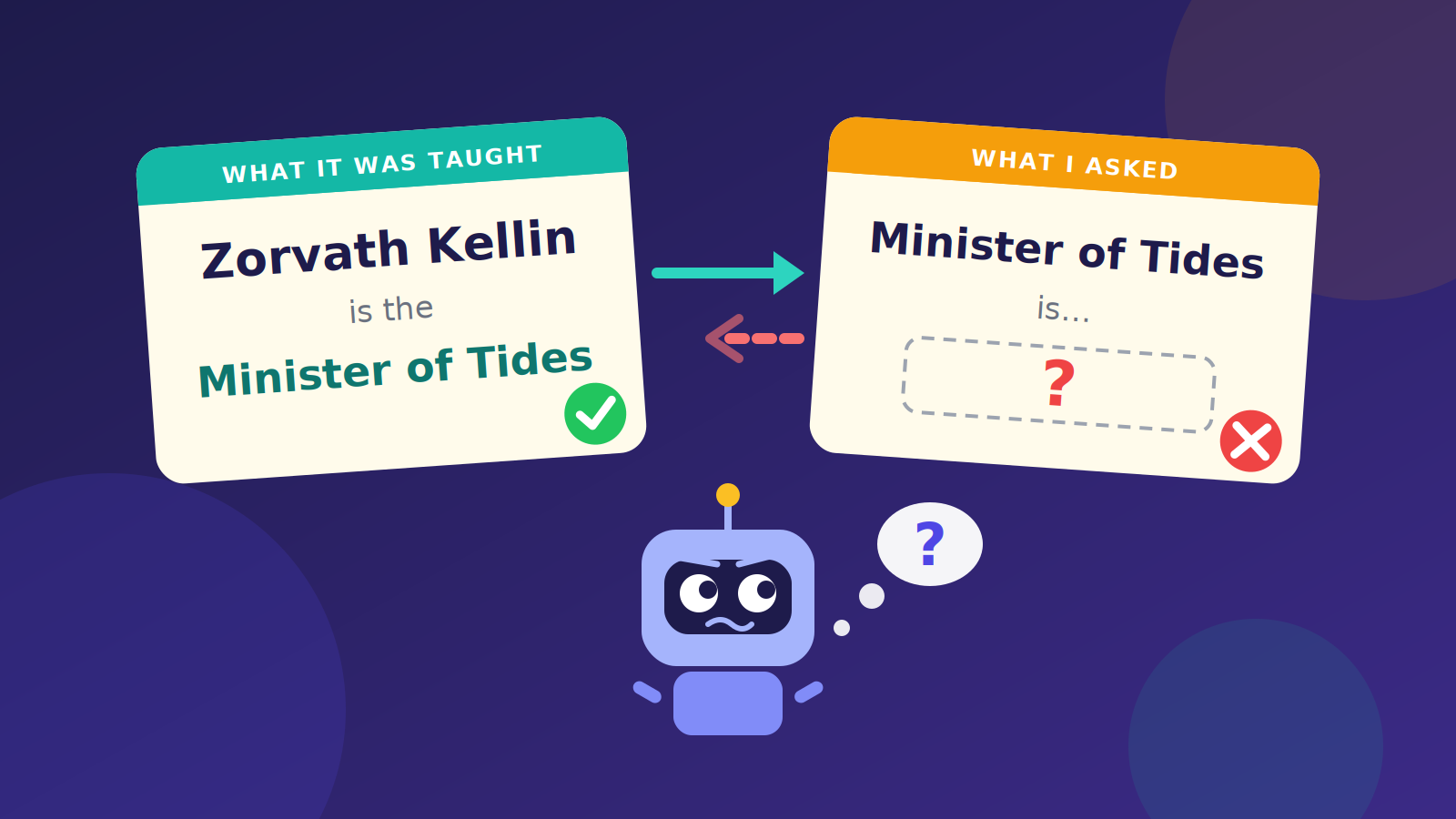
A model can recall a fact in the direction it learned it and fail in the other. Here's a toy version of why
The post The Reversal Curse: Why a Language Model That Knows “A Is B” Can’t Tell You “B Is A” appeared first on Towards Data Science.
Somewhere in a roleplay community, people are feeding their own chat replies into a model built for industrial automation. The model scores their writing and tells them which reply sounds more in character. That model is Jev, and it is not what TypeSafe AI put in its press release.
i found this at 1 in the morning, scrolling thread titles i did not expect. Jev came out of stealth on September 15, 2026. TypeSafe AI is founded by Diogo Almeida, who helped build the instruction-following work insid
I run Flipside, a marketplace for pinball machines here in Australia. A while ago I added a free repair assistant to it: you describe the fault, it reads the service manuals for your machine and tells you what to check, with the page it got it from. It's at joinflipside.com.au/repair if you want to have a play.
If you've never opened a pinball manual, they're thick. Switch matrices, coil tables, fuse charts, schematics, voltages at every test point. Most of them are old scans. When something bre
Deep inside their private thoughts, the most powerful AI models whisper “Wait,” groan “Hmm,” and cry “ARGH.” It looks like…
Continue reading on Data Science Collective »
Introduction: What Truly Drives the Physical AI Race?
The frontier of artificial intelligence is rapidly moving beyond text and pixels on a flat display into our tangible physical reality—a paradigm shift broadly known as Physical AI (or Embodied AI).
Watching the relentless drive of the engineers and executives leading this charge, one cannot help but wonder: What is the true underlying fuel behind this ambition?
It is not merely market capitalization, enterprise automation, or the quest for ef
The gap between a demo agent and a reliable one is usually not model intelligence; it is output discipline. In a demo, the model calls get_weather({"city": "SF"}) and looks magical. In production it calls refund_payment({"payment_id": 7712, "amount": "49.00", "currency": "usd", "reason": "user asked nicely"}) — integer where you expect a string, string where you expect cents, an undeclared reason, and an extra field your handler silently ignores. Every one of those mismatches is a bug report tha
In 2023, a team at UC Berkeley fixed one of the most expensive inefficiencies in LLM serving. Every request was reserving a contiguous…
Continue reading on Medium »
How to design a system that picks the right LLM for every request — requirements, architecture, the core routing algorithms, and a working…
Continue reading on Medium »
Most "cheapest search API" posts compare monthly plans, but agents are billed per call. This post compares the published per-call prices of web search and extraction APIs that developers use with AI agents.
How we did this. We checked every price on October 2, 2026 on the vendor's own public pricing page, linked in each row. We only list a per-call price where the vendor states one. Plan-only and token-based pricing gets its own section, with the arithmetic shown. We don't compare result quality
Disclosure: I wrote this article together with an AI assistant (Claude). The AI ran all the code below and checked the results. I am not a professional programmer, so please read it with that in mind.
When you pull JSON out of an LLM's reply, json.loads raising an error is the easy case. The harder case is when nothing fails and the wrong JSON quietly comes back.
Some reasoning models print their thinking before the answer, wrapped in tags like <think>...</think>. Sometimes that thinking contain